Thursday, July 19, 2012

Why Twitter and music industry are dependent on each other?

Particularly in last 2 decades, there have been lots of changes in the music industry as well as in the ways we find and listen to music: from cassettes to mp3s, from radios to online music streaming platforms. Below is a nice animated infographic from Digital Cowboys showing the world of digital music:


Especially with the booming of social media, it became a lot easier to discover new musicians, to follow your favorite artists and to keep in touch with them. Here is another interesting infograph by MusicMetric showing the trends after SXSW - South by South West 2012 festival where all new talent are presented and promoted.


Back in the time, Myspace was a lot of help to discover new talent and follow your favorite musicians but there are other social media tools replacing it now. Such as Facebook, Twitter, Youtube, SoundCloud, Beatport, Pandora, etc. There are many services being provided to fans and musicians too. For instance, last year Foursquare signed a partnership with British Songkick to enable fans to check in not only to places but also to events, gigs or concerts.


Among all these tools, Twitter has a key role for musicians and their fans. Twitter defines itself as "the next best thing to being backstage for music fans" in a guide they prepared for musicians and artists. In October 2011, Twitter transferred Tatiana Simonian from Disney Music Group and appointed her as the Head of Music Industry Relations for Twitter. This was almost at the same time they launched Twitter Music. Twitter certainly pays special attention to music industry and is aware that music is a key industry for growth. During International Music Summit 2012 held in Ibiza, Ms Simonian had a key note speech. These are the highlights:
50% of all users on Twitter follow at least 1 musician... 87% of Billboard top 100 are on Twitter... The top 5 most followed accounts on Twitter are musicians... The hashtag EDM* is now used up to 3,000 times a day. It is the fastest growing genre.
However it isn't only musicians and fans need social media tools, the tools need them too. According to a recent article from The Wall Street Journal, social media platforms are heavily dependent on music fans for growth. As a proof to this, Twitter Counter reports that 7 out of top 10 followed accounts belong to musicians. Lady Gaga, Justin Bieber, Katy Perry, Rihanna and Britney Spears are the top 5 followed celebrities on Twitter. FYI, Barack Obama is the 6th.

Twitter is encouraging the musicians to use Twitter as a main tool to communicate with their fans. Within the guide, they give such advises:
  • Include photos in your tweets
  • Create hashtags for your tours
  • Reply to your fans
It's interesting to see that the only reason Twitter cares about musicians isn't the growth. They are making money out of this. According to TechCrunch, Twitter signed a partnership with 3 music data services at the beginning of 2012 and will distribute tweets of verified musician accounts to be integrated into consumer apps.

At the end, it's a mutual relationship between musicians and Twitter. For musicians, Twitter isn't only about being discovered and followed by fans but also a way to connect with other artists and bands too. As John Paul Titlow from ReadWriteWeb explains, "For musicians today, especially smaller, independent artists, not taking full advantage of the social Web is a huge missed opportunity".


*EDM stands for Electronic Dance Music.

Twitter - Building Community and Communication Around Your Conference


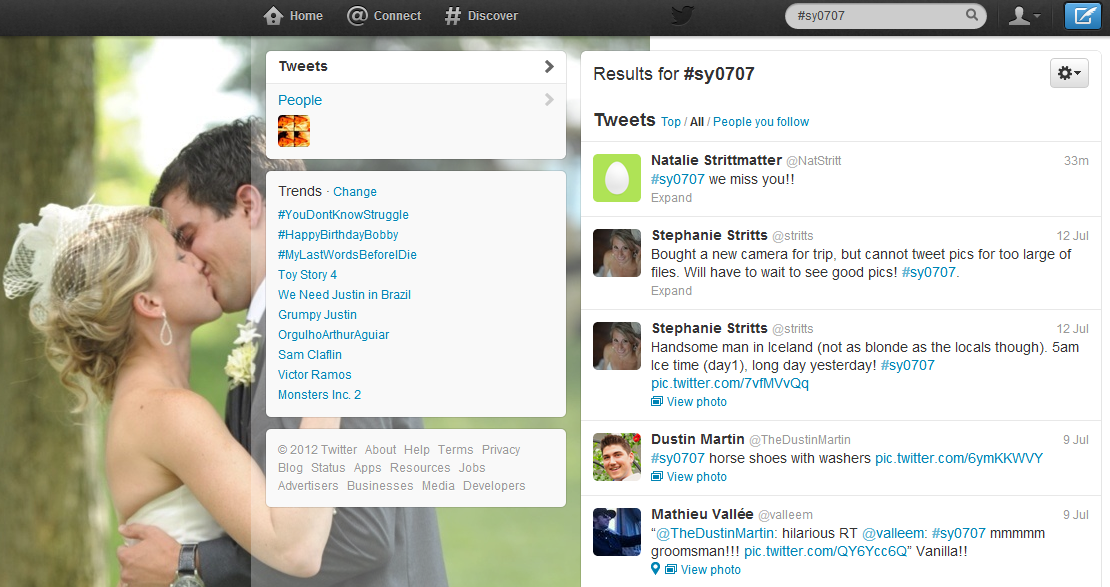
At my sister’s wedding a few weeks ago, my husband, an IT professional, had the great idea
of creating a twitter tag for the wedding and having all the guests post their thoughts, feelings and interacting with one another in real time on a massive screen for all to see. Now, my sister through her hashtag, #sy0707, has a complete timeline holding the story of her wedding documented on Twitter. Tweets started during the rehearsal dinner the night before and the bride is still to this day tweeting honeymoon photos.


When my husband, the wedding emcee, first announced the concept of twitter at the reception, the crowd went silent and looked very uneasy. He responded “It’s 2012, people... we can do this!!! I’m an certified IT professional, let me show you.”  Everyone laughed.

A few young guests were quick to pull out their phones (our early adopters), but the majority of the people were hesitant at first. As posts began to appear, the concept took off. Guests started posting through their phones. People were grabbing my husband and handing over their phones demanding to be setup. Those without phones started posting through their neighbours’ phones. The photographer was able to post photos taken mere moments previously, for all to see.

One guest dared the head table to dance on their chairs. This tweet was viewed by every guest live as posted and was met with a roar from the other guests. The head table all got up and obliged the request and the interaction injected a wave of youthful enthusiasm into the reception.

Since that night, I’ve been thinking about the application of this social media platform for corporate events. Instant feedback, conversation and history.

For the twitter feed to be successful, the organizing committee must be prepared to devote resources to managing the social media tool.  Participation is crucial, and since a blank feed is not inviting to new users, people need to see interesting and engaging tweet to get them to join the conversation. As resources are always scarce this is a real business issue.  Do businesses see the value proposition that Twitter can offer them sufficiently enough to make that dedication? 

Some of the arguments/benefits for incorporating Twitter in your upcoming conference.

●        Deepen Learning: Twitter allows guests to interact with each other, share what they have learnt, insights and highlights from the differing speakers.  This added layer of interaction can help deepen their learning experience.

●        Instant Collaboration: “Twitter [provides] a simple way for attendees at a conference to share thoughts about particular sessions and activities with others at the event and those unable to attend.” http://bit.ly/xJ9Ol2 (This resources als dives deeper into how Twitter can be used in the classroom)  

By throwing out an idea for all to see, guest are able to efficiently build on each other thoughts  in a manner that would not be easily achievable in a typical group setting.   A thought added by one person in one corner of the room can be built upon in an instant by someone else across the room who they may have never even met. Therefore instant collaboration is achieved.  Also allows guests to share resources as Twitters offers an easy way to post and share resources.

●        Communication: Announcements can be easily shared through Twitter a feed for all to see. Displaying the feed at the event on a big screen could also temp others who aren’t currently using twitter to join the conversation.  Much like what we experience at my sisters wedding with guests looking to get signed up and participate.  Twitter also allows guess an outlet for posting questions, other guests may answer thus saving the staff time.

●        Increase Hype: By creating a digital footprint for the event on Twitter you can increase hype before, during and after the event - may even help spread the word and increase event participation.

●        Cost Effectiveness: Lastly and what every business man/woman would like to hear - Twitter is a cost effective communication tool.

During a recent study, when asked their personal opinions on Twitter conference attendees thought - the tool was “useful to discuss, share and spread information” and helped “build community”. http://bit.ly/NIoJEK  ( A good read)

Here another resource I would also like to share a very basic video but good intro to twitter for anyone who is less familiar with the tool. Twitter 101 for Conference Backchannels -


If you are attending an upcoming conference and want to know if they have their own hashtag check out  - http://twubs.com

Wednesday, July 18, 2012

Social Media can help your business with inbound marketing


Are you the owner of a small business? Don’t know how to get more traffic and increase your sales? Are you afraid of the time Social Media handling may consume? Maybe you should consider inbound marketing through HubSpot.
They consolidated well known Social Media tools (Blog, Tweet and Analytics) and marketing components (which deserves a separate blog) into one application, hence the name HubSpot. This tool is not concerned about teaching you how to send a tweet or blog but in instructing users on how to generate/write the best content which will, in return, generate the biggest amount of leads in the least amount of time.
 

Blogging has a direct correlation to visits to a particular web site therefore if a blog is well written it will attract leads. The strategy used by HubSpot ‘s Social Media Component (SMC) is to help you write blogs that contain the best structure and key words. While writing your blog, suggestions of words will pop up on screen; these suggestions are generated by an embedded Search Engine Optimization (SEO) component which applies algorithms to your blog text in order to try to find the text that will generate the best chance of organic search results. While performing these sophisticated operations the SMC will also automatically add Social Media icons to your postings so you can focus on the task of most importance.

In addition the SMC provides blog analytics that will help you to track the efficiency of your postings so you can adapt to the conditions surrounding you.  The time the postings are more effective, which postings generated more traffic (views/comments) and the traffic to leads relationship (number of inbound links for each post) are all tracked by the tool and displayed.

Monitoring for key words on SM such as blogs, twitter, Facebook, and YouTube,  and keeping statistics of it may be relatively simple to execute but extremely time consuming when you are constantly doing it. The SMC can also monitor mentions of your company, competitors and keywords relevant to your business and generate a graphic with the consolidated data to show the “Social Reach”

One can also program the SMC to automatically share content from blogs to other social media channels and bulk schedule tweets for multiple accounts.  Again, not rocket science but time consuming grunt work if you are doing it “by hand”. 

HubSpot is not a revolutionary concept but it aggregates a lot of needed functionality – which can be found in many separate tools – in a single package which provides consolidated data of different sources in a mash up style. Hard to say if it is worth the money you pay monthly (I guess it depends on your line of business) but I would be inclined to try 2 month free trial if it was available. 

References:
[1] Prescott, Bill (February 5, 2012). "Business Sense: Inbound Marketing". The Times Standard. Retrieved February 27, 2012.
[3] www.pcmag.com

OC Transpo Fails…again. How about giving riders a say?!


OC Transpo recently postponed the launch of the new smart-card payment system for riders, Presto, from July 1, 2012 to February 2013. This delay is the result of glitches in the system’s software and hardware that have not been fully identified by the system supplier, Metrolinx. Once again bus riders, the most affected party, are left in the dark and disappointed. The City of Ottawa should consider involving its primary stakeholders when it comes to projects like these. The use of social media would be a great platform through which riders could be kept in the loop of the project’s progress, as well as provide valuable insight for the both the supplier and the city along the way.

(You may have wondered what one of these green machines was on your commute today!)
The City of Ottawa contracted with Metrolinx in 2010 for a total project cost of $25 million. OC Transpo began to publicize the introduction of the new system in early April 2012. Advertising including the July 1st launch date, introduction to the Presto system, and website links for further information were placed on several buses and bus stops. The new card readers at the entrance of the bus also drew riders’ attention. 
 A “Family and Friends” pilot for the system began in May with 1,000 participants. On numerous occasions throughout the month the readers on the buses failed to accept riders’ smart-cards. Errors included blank screens, inaccurate balances, and failure to take payment. To the disappointment of riders, the City of Ottawa cancelled the July 1st launch date in late June when it determined Metrolinx was not even able to pinpoint the problems with its product.
On June 21, 2012 the Ottawa Citizen published an article with full details of the negotiations and political background regarding this deal.

So why did it Fail?
The City of Ottawa and Metrolinx engaged in a very high risk project involving a new market and a new and untested version of a product that ultimately failed. Of all possible market-product strategies, this is by far the riskiest approach. The project failed because the timeline of the two desired outcomes, new product and new market, were not managed in unison. Advertising of the new product to the primary stakeholders of this project, bus riders, was undertaken well in advance of the new product being ready for the market.

What should OC Transpo have done?
OC Transpo has a tumultuous relationship with bus riders due to fairly recent events; effective communication is essential to avoid further aggravating this rapport.

 (“Bus driver swearing at rider”: Remember this fiasco?!)

OC Transpo should have used its online presence to create a Presto Forum where riders could have been made active participants of the project. Using existing Social Media (Twitter) to log-in to this forum would have reduced the amount of rogue comments, holding individuals accountable to practical and constructive criticism.  By keeping all stakeholders in the loop, OC Transpo would have been able to avoid major surprises, and riders would have probably understood that this was ultimately the supplier’s product issue, not OC Transpo’s responsibility.

How would the conversation have started?
We’ve all proved that advertising on bus signs work (very few people can claim to have never even glanced at one during their commute); OC Transpo could have begun a Twitter conversation with #PrestoOttawa posted on a bus sign: soon thousands of riders would have been engaged. This conversation would lead all interested riders to the Presto Forum on the OC Transpo website where updates, news, and comments regarding the project would have been welcome. Any delays, such as the one that occurred, would have been announced earlier and progressively keeping riders informed of the step by step process. The use of Social Media in this situation would have avoided for OC Transpo to once again have to fight the uphill battle of regaining riders’confidence. 

Fellow OC Transpo riders, are you also tired of being kept in the dark?

Sunday, July 8, 2012

social media tools in China


Whether the company is starting out, just starting to turn a profit or already on the verge of an acquisition, as an entrepreneur he will be constantly evaluating the tools that will help get his business to the next stage.

Even if the business is still using the ink as the most often style, they want to be equipped with the social media tools that will play an important role in company communication, product and brand promotions, and business development for the startup.

As I come from China, I have some idea about the social media in my country. In China, there are many social media tools, such as RenRen, QQ, Weibo. Most people use these tools to communicate with family, friends even strangers. At the beginning, the most part of the customers are young people. But now it has been developed to the life of every people. Not only the young like to use social media, but also the older people use the media keeping connect with others and getting to know the world.

After the booming development, social media is becoming more and more popular and important. With the rising number of user, many companies take part in the social media to extend their business.

Companies branding can get obvious benefits using social media. Whether users directly engage with the brand or not, they will still see the brand’s name within the networks they use. The more impressions a consumer gets of business, the more likely he will remember the company’s name in the future. And also social media can provide support to customers. It is vital to the success of any business and social media is no exception to the rule. When a person reaches out to you, whether their input is good or bad it is extremely important to respond in a timely and helpful manner. Social media provides the platform for consumers to interact on a person to person level, so that they aren’t talking to a faceless representative over the phone or via email. Respond whenever a user reaches out, just not to users acting profane, misleading or hateful. Providing this level of service, which can be something as simple as thanking someone for mentioning the brand, is completely transparent to the entire network, showing how dedicated the companies are to their audience?

In any business it is really important to keep pace with their competitors and get to know everything about the same service the company also have. Social media merely makes this process easier by allowing for complete transparency of the content and conversations their competitors are having on their various social accounts. Social media can help keeping company on track with other non-profits, businesses, publications or whoever the company interested in keeping tabs on or on the other side of the fence looking to partner with in the future for a promotion, campaign or some other type of partnership.

In my opinion, it is a platform for the customers and companies to communicate. It is an information era now. In this life style, social is the real media, life is the best communication. Business can get more success using the social media in the real life.